

How Typewriter Poetry Changed My Perspective on Art
Two years ago, my friend Alyssa asked me if I’d be willing to set up a typewriter at Bedford Greenhouses for their annual Valentine’s Day event. Knowing my passion for poetry and having seen street poets on different pockets of Instagram, she thought it would be a neat idea for me to try.
I said yes without hesitation... or at least without enough hesitation to say no. In the days that followed I bit my nails into oblivion as I learned how to type the way my parents did (with a metal contraption that makes ding sounds).
That Saturday, I set up a little table with a simple sign: “Give me a word and I’ll write you a poem.”
I remember praying to God before people showed up: “Lord, let these words come from you, so they might speak to wherever people are at.” I had never shared my artistic perspective in such a vulnerable, spontaneous setting, so this prayer was as much a trust fall as it was an invocation.
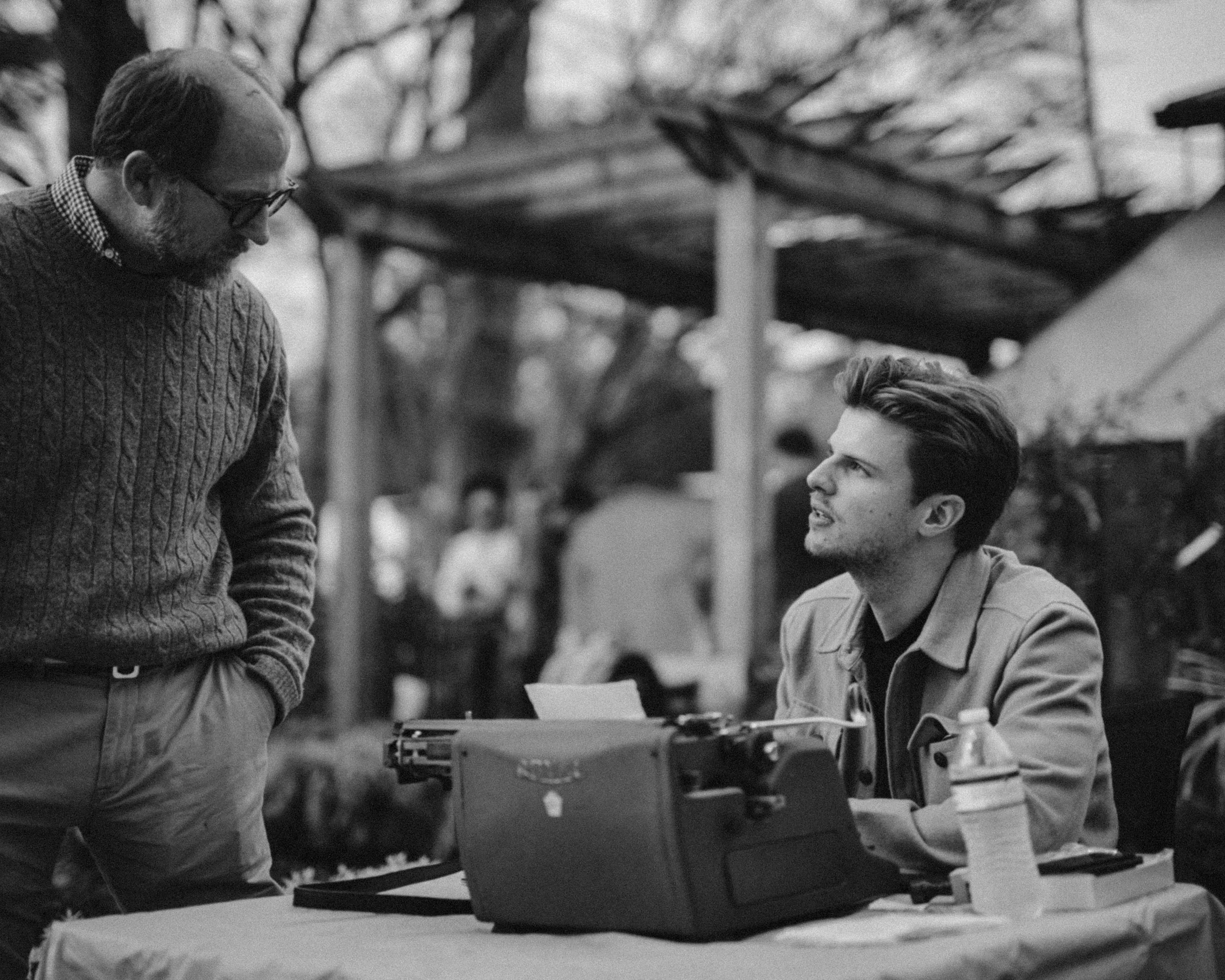
And sure enough, people asked for poems. They asked for poems about family, forgiveness, grief, their favorite flowers, Taylor Swift music, and love (in the spirit of the holiday of course). I could feel the imaginative kid inside of me coming up for fresh air to come up with ideas. It was like finding hidden treasure under my feet. Hearing people share their own inner worlds so that my inner world could talk to theirs… it was so special. But it was something more than that. Something more than a feeling of affirmation.
That day, after pondering for a minute, a man approached me and asked if I’d write a poem inspired the word overcome.
“Hmm,” I said. “Overcome the adjective, like overcome with emotion? Or overcome the verb, like overcoming a trial?”
“The second one,” he replied.
I got to work. After finishing this poem, my inner critic immediately decided it was too simple, too aphoristic. And yeah, it’s no Dickinson or Elliot. Plus I flinched when I stamped it—so the stamp looks imperfect.
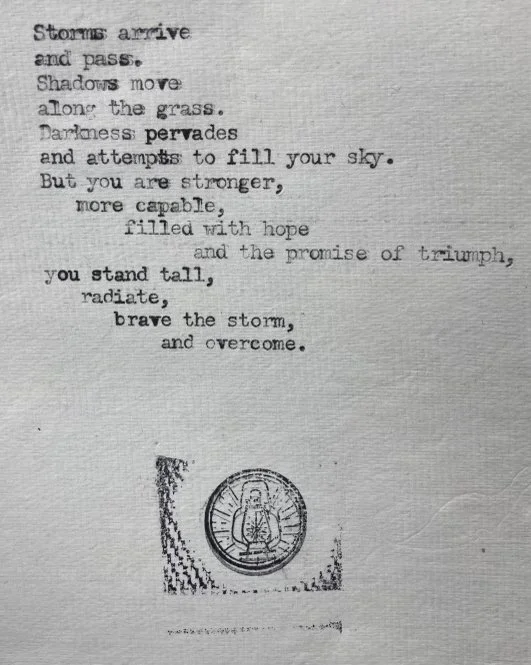
But later in the day the man’s wife came to pick up the poem. She immediately got choked up and remarked, “It’s perfect. Thank you for being vulnerable enough to write this.”
I smiled and thanked her. Later, the man texted me: “The poem was amazing. My mother was diagnosed with stage 4 colon cancer this week and this is for her.”
I remembered the prayer I prayed to God and felt the words must’ve come from somewhere else… and I don’t mean ChatGPT. It would have been unfair to withhold or edit this poem into oblivion—when it was exactly what they needed right then.
My mentor Nick asked me if I got tired by the end of the event. “Honestly, no,” I said. “If I could, I’d sit and write poetry for people I’ve never met all day, every day. It’s energizing.”
Since then, I’ve had the opportunity to write at local markets, coffee shops, events, and most recently weddings. It’s been amazing and I am so humbled by people. How people are so diverse and strange. How they each have stories that fit into God’s tapestry of humanity.
This past Christmas, I performed typewriter poetry at a Christmas market. A woman named Rose came to me and curiously looked through my photography prints and premade poems. She had a vibrant presence and gentle enthusiasm about her.
I asked her if there were a topic she would like me to write about. Her eyes widened a bit, “You can write anything right now?”
“Yes!” I replied excitedly. “Let me know if you have a prompt.”
Rose contemplated for a minute or two. “I have one, but it’s… sad. I don’t want to make you write something sad.”
I sobered my expression. “Well that’s okay. I don’t mind if it’s sad, if you don’t mind sharing.”
“Well, last year my husband and I had a baby boy for six weeks. He was my whole world. And I would love for you give me words to say to send to him. In heaven.”
My heart dropped. Speechless for a moment. “Oh. Wow… I’m so sorry for your loss. I can definitely write that for you.”
She went to grab coffee with her husband as I sat at my typewriter thinking of words to say. No sooner could I think of a word did my eyelids buckle. A group of PhD students showed up. One of them asked if I could write a poem for her boyfriend. “Oh yeah, absolutely,” I said, wiping the saltwater off my cheeks. “Sorry… uh, anyway, tell me about him.”
A half hour later, Rose returned with her husband to pick up the poem about her baby boy. Her eyes filled with bittersweet embrace as she read it. She showed her husband the piece. His disposition was similarly cheery, if a bit more energetic. But I can’t remember their reaction, what they said about it. By this point I had written a handful of poems about loss and grief, but none that cut so deeply, so immediately. It must be the single most bittersweet experience a human can have: to gain, then lose a child. And that’s all I can distinctly remember.
“How are you two so… happy… calm,” I said to the couple.
Rose smiled softly under her glass eyes. “Well, I guess that’s all you can be. Just see the good in everything. We’ll meet him again in eternity.”
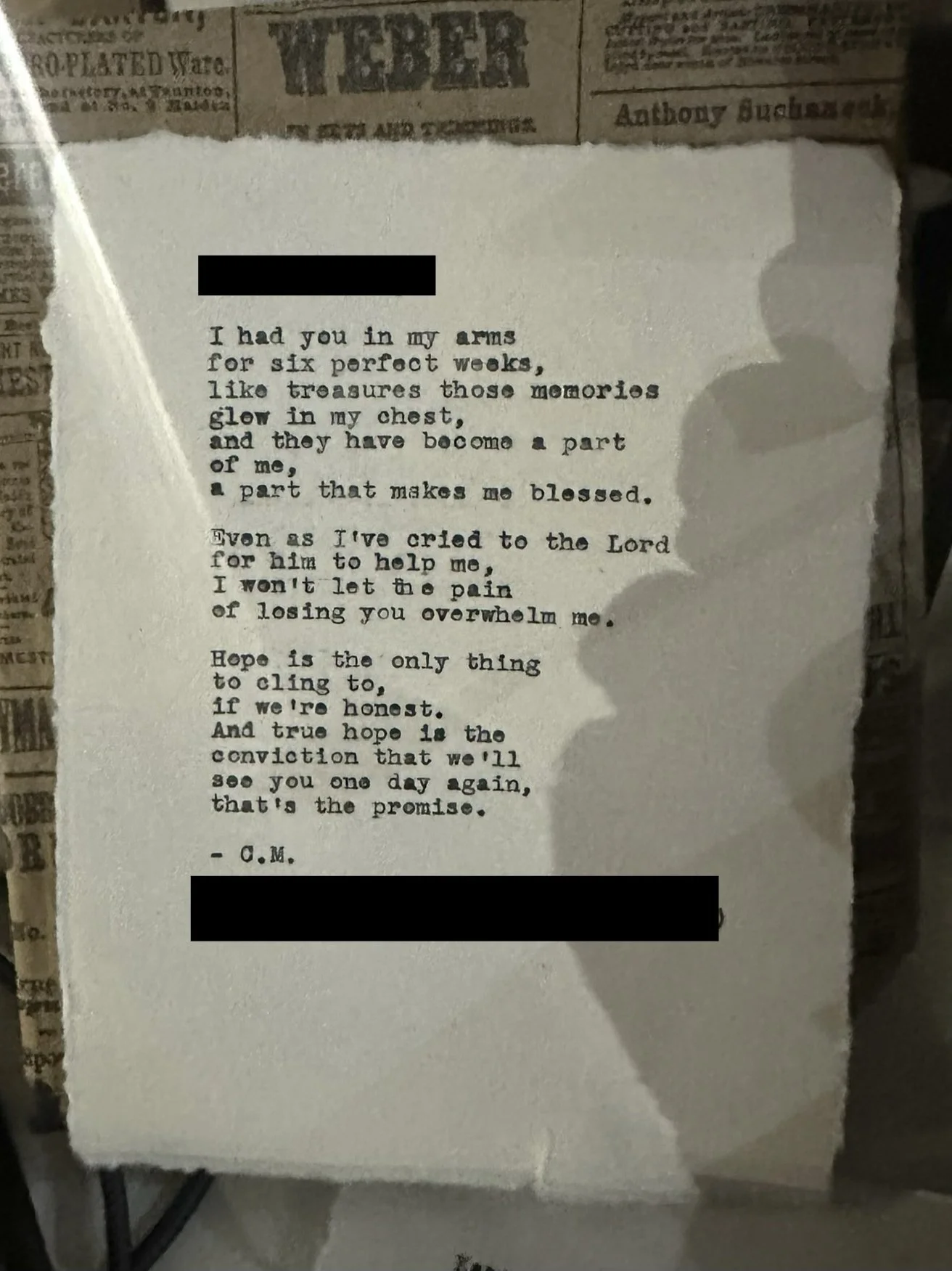
“We’ll meet him again in eternity.”
As they walked away, the realization crystallized: through live poetry, I get to see humans at their deepest for a few minutes. And that’s why this has felt like something beyond sharing my art. I’ve learned so many new perspectives through the eyes of passersby, and God has been there in those moments. Whether when I’ve made heavier poems like this. Or when I wrote a light verse poem for a college guy to confess his feelings to his crush while his best friend cheered him on. Or when I wrote a poem about a silly nickname a woman gave her toddler son when he would stick his tongue out, which made me laugh so hard.
I’ve been so lucky to glimpse the hidden thread in all of us. It changes slightly between each person, and it teaches me something new each time.
Honestly, I’m not an academic poet. I don’t have expert knowledge on the great poets through history. Most of the poems I’ve written in my life have been loosely metered and riddled with flowery language and cluttered wordplay. But the poems I share with strangers are honest and prayed over.
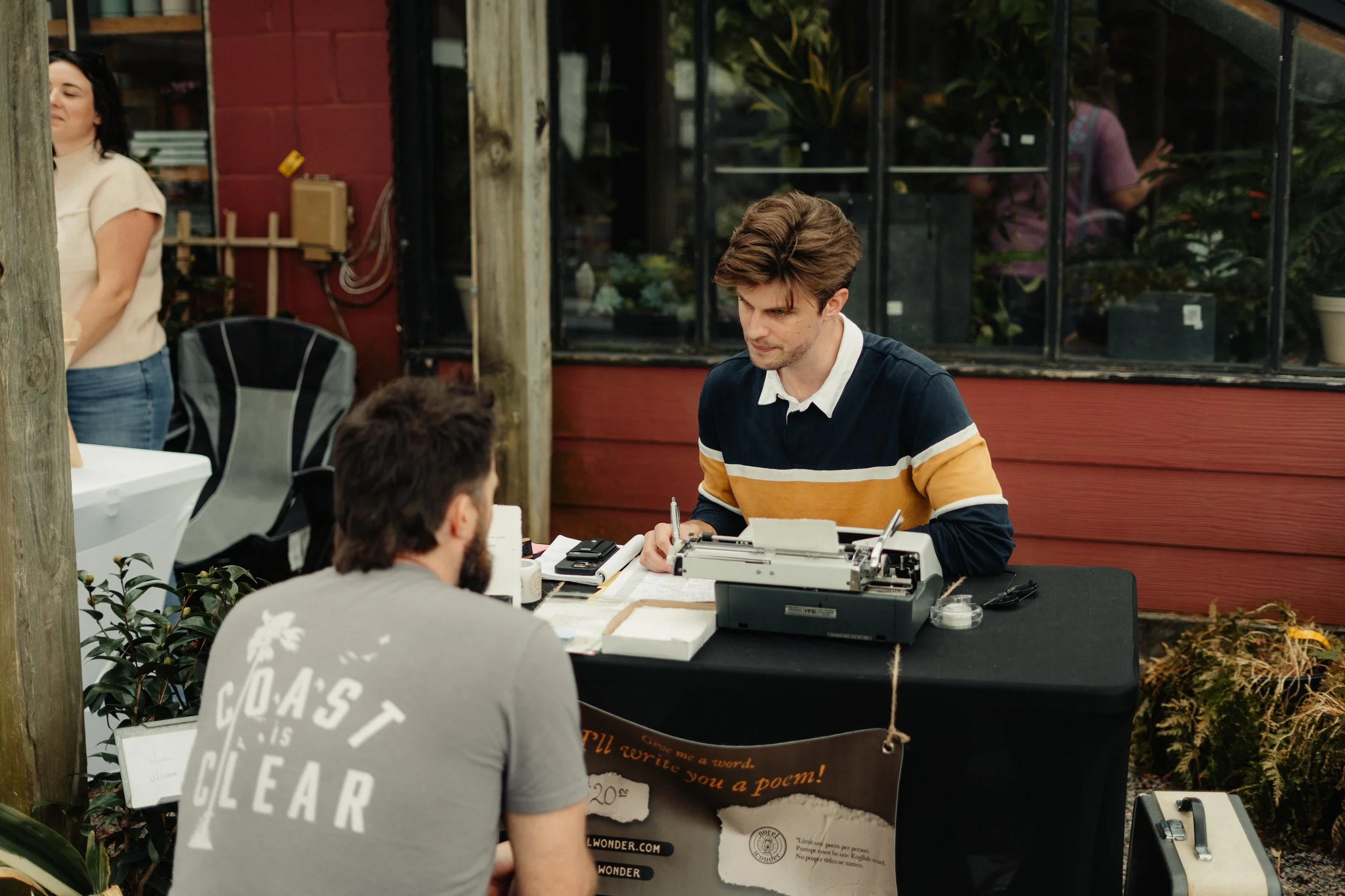
And I believe this kind of messy, unfiltered human art is an invitation to the sacred if we really allow it to be. Through honest and imperfect art, we open ourselves up to knowing others in a way that’s deeper than a list of traits. Music has that seizing power. Paintings and sculptures open our eyes to beauty. The right word, in poetry or prose, gets us in touch with not just our emotions but each other, in a way that social media doesn’t quite manage.
Over the last two years there have been many times I’ve contemplated whether custom poetry is really worth it. Whether people really care. And as soon as those thoughts sink in, I meet someone who is grateful I took the chance to share.
And I believe it’s because art is its own kind of communion. For you and me. As with so many creative and entrepreneurial endeavors, when we cage our gifts deep in our chest and think, Am I really good enough to share this? we limit the beautiful messages God can convey through us, and we limit the amazing connections we can create with other people, other hidden stories, other seemingly normal passersby.